Why Usability Decides Whether a Product Succeeds
A product can have brilliant technology and still fail. If it is uncomfortable, confusing or awkward to use, people try it once and put it aside. Usability is not a finishing touch added at the end of a project. It is what turns a working technology into an experience people want to repeat, and very often it is what decides whether a product succeeds.
What usability really means
Usability is the difference between a product that works and a product that works for people. It comes down to two things. The first is comfort: the body feels supported, relaxed and safe while using the product. The second is intuition: people understand what to do without instructions, because the shape, the interface and the feedback guide them. When comfort and intuition come together, the experience feels natural, almost invisible.
When the technology is ready, but the product is not
We saw this clearly with Nimble, an at-home device that paints your nails automatically. When the project reached us, the technology was already there. The earlier design, however, used a rigid part built into the device to hold the hand in place. It fixed the hand in one position, and it was not comfortable. We knew that, in that form, the product would not be the success it deserved to be, no matter how good the technology inside was.
A modular cushion for a relaxed hand
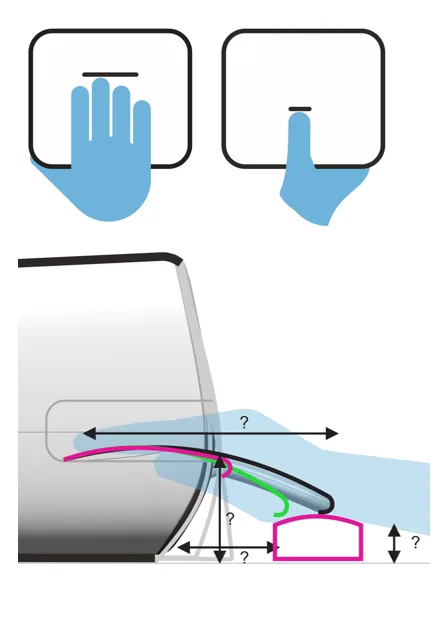
Instead of a rigid support, we designed a soft, modular cushion. It can be taken out of the device and placed wherever it feels right along the wrist, so every user finds their own position. The hand rests on it naturally and stays relaxed during the whole process. Through multiple ergonomic mockups and testing cycles, this cushion concept proved more flexible and much more comfortable than a fixed support.
Holding the hand without closing it in
We also worked on the opening where the hand goes in, testing it in multiple positions. The challenge was a balance between two needs. On one side, the device has to hold the hand steadily, so the painting is precise. On the other side, it has to leave the hand free enough so the user never feels trapped or claustrophobic. We shaped the product so the hand opening is the main element, while the volume of the device moves into the background. The result feels open, inviting and calm.
Comfort plus intuition: how it all comes together
A seamless experience is never the result of one element. It happens when ergonomics, interface, form and mechanics all point in the same direction. At Nimble, we worked closely with the mechanical team so that the cushion, the hand opening, the minimal interface and the enclosure were designed as one system. When every part supports the same experience, the user does not notice the design at all. They simply feel that the product is easy and pleasant to use.
How we design for usability
Every project is different, but a few principles guide our work:
- Start with the user’s body and feelings, not with the technology.
- Build ergonomic mockups early, and test them with real hands and real positions.
- Look for the balance between support and freedom, precision and comfort.
- Iterate before tooling, when changes are still fast and affordable.
- Keep design and engineering together, so the experience survives all the way to production.
The result
An integrated hand cushion, a minimal interface and a carefully refined enclosure gave Nimble a premium, comfortable experience. Its 2021 Kickstarter campaign attracted 5,877 backers and $1.8 million in pledges, far above its $25,000 goal. Nimble was later named a CES 2024 Innovation Awards Honoree, and in 2026 it was acquired by 10Beauty. Great technology made it possible; a natural user experience helped make it a success.
If you are developing a product and want it to feel as good as it works, explore our industrial design and engineering services or see the full Nimble project. We’d be happy to talk about it.
Read next: How We Create a Product Vision: Designing With Empathy